Smallcap Investors Look Away: Over 600 Stocks Already Posting Double-Digit Negative Returns in 2026.
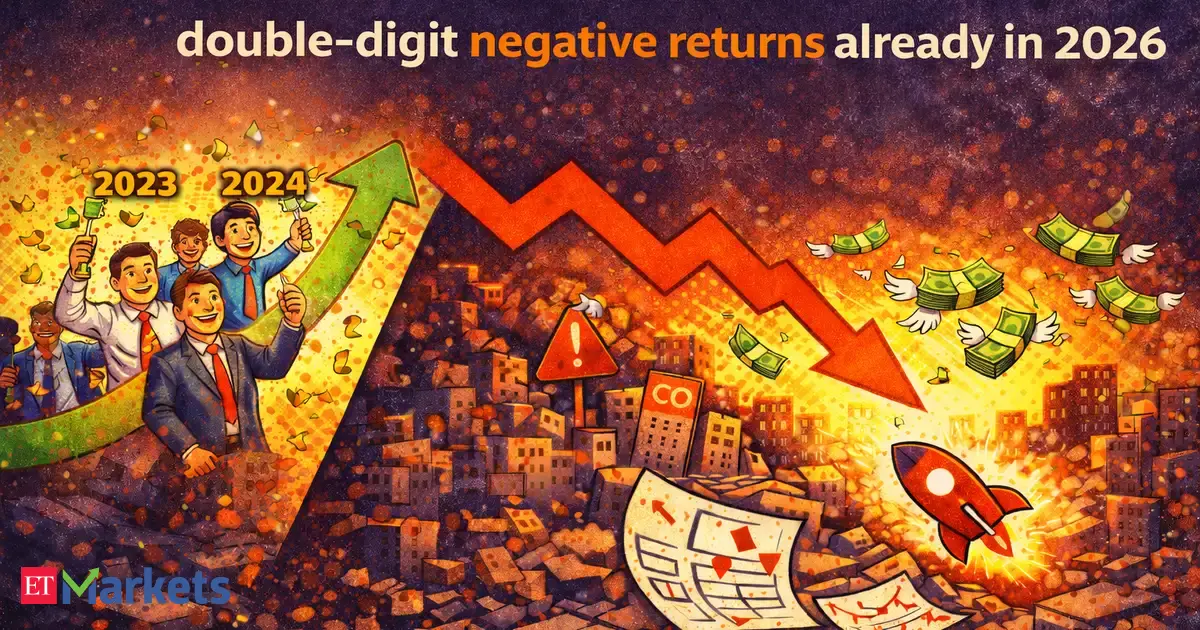
This fix has been in the works for almost a year. The market, which had been strong on the back of liquidity, retail participation and optimism about India’s growth story, began to fragment downwards. With strong balance sheets, predictable earnings, and institutional support, large-cap stocks have largely weathered the storm since the past year.
But small-cap and small-cap stocks have struggled to maintain ground as earnings momentum slows and valuations come under pressure. In 2025, large-cap investors managed gains of about 11% for the year, driven by improving fundamentals and clear earnings visibility.
After achieving massive returns of 44.6% in 2023 and 24.5% in 2024, midcaps still achieved returns of around 5-6% in 2025 despite increased volatility. Forward valuations for mid-cap stocks eased to around 27.8x, while earnings growth and revisions continued to remain above 20%, helping drive returns.
But Smallcaps couldn’t keep up. The small-cap index fared even worse, down nearly 19%, while the small-cap index ended 2025 with a loss of about 7%. What initially looked like a healthy consolidation has now escalated into a widespread sell-off that has investors increasingly worried.

This trend intensified in early 2026, with hundreds of stocks plummeting, many of them falling significantly without any immediate company-specific triggers.
Some well-known smaller companies have already made big cuts this year. Shares of Kiri Industries fell nearly 35% and Balu Forge Industries fell more than 33%. Systematix Corporate Services was down more than 31%, and Lotus Chocolate Company was down about 31%. Other stocks such as Genesys International Corporation, Worth Investment and Trading, Allied Blenders, Nectar Lifesciences, Gujarat Themis Biosyn, Amal, Sai Silks (Kalamandir) and Cupid have all fallen between 27% and 30% in just a few weeks in 2026.
Is it getting worse for investors?
Analysts say the correction is no longer simply about excess valuations. Weak earnings growth and corrections in the broader market have made broad participation risky. Many small businesses that have benefited from easy liquidity and optimistic growth assumptions now face more difficult questions about profitability, cash flow and balance sheet strength. In this environment, even the slightest disappointment is quickly punished.
Technical indicators also point to continued pressure. Emkay Global points out that both mid-cap and small-cap indices remain relatively weak, reflecting a shift from sideways to bearish sentiment.
“Nifty Midcap 150 is trading in a sideways to negative trend with immediate support between 21,800 and 21,600. It is likely to remain under pressure as long as the index remains below 22,000. Nifty Smallcap 250 is moving within a descending channel and hovering near an important base around 16,000,” the broker said.
A clear drop below this level could intensify the selling and push the index towards 15,400, highlighting the risks that still remain in the broader market.
Despite the bleak situation, fund managers are not uniformly pessimistic about the medium-term outlook. Sunil Sharma, Chief Investment Strategist, Ambit Global Private Client, believes that the main challenge for investors is weak earnings growth and limited upside correction, making indiscriminate exposure to small-cap stocks risky.
His outlook for 2026 is built around selectivity, as bottom-up investing through experienced fund managers appears likely to perform better.
V Srivatsa, senior vice president and fund manager at UTI AMC, also sees the valuation gap between large and small caps as an important factor in 2026. Small and mid-cap indices continue to trade at a premium to large caps, and Srivatsa believes this premium will become important as investors re-evaluate risk.
In his view, large-cap stocks are better positioned to lead any recovery, given the stability of valuations, stronger balance sheets and more predictable earnings streams. Smaller stocks may bounce selectively, but companies that offer scale, financial strength and visibility are more likely to maintain leadership.
Others argue that although the current phase is painful, it can reset expectations in a healthier way. After a bruising 2025 and weak start to 2026, the small-cap narrative is shifting from momentum-driven optimism to discipline and quality.
CA Anupam Tiwari, founding member and head of assets at Groww Mutual Fund, believes that 2026 may still turn out to be more constructive for small caps, but not through a broad-based rally as seen earlier. Instead, he expects returns to be generated by companies that can deliver bottom-up stock selection, balance sheet discipline, and quality-led growth.
(disclaimer: Recommendations, suggestions, views and opinions provided by experts are their own. It does not represent the views of The Economic Times.)