Oklahoma State Considers Bitcoin Payment Option for Government Employees

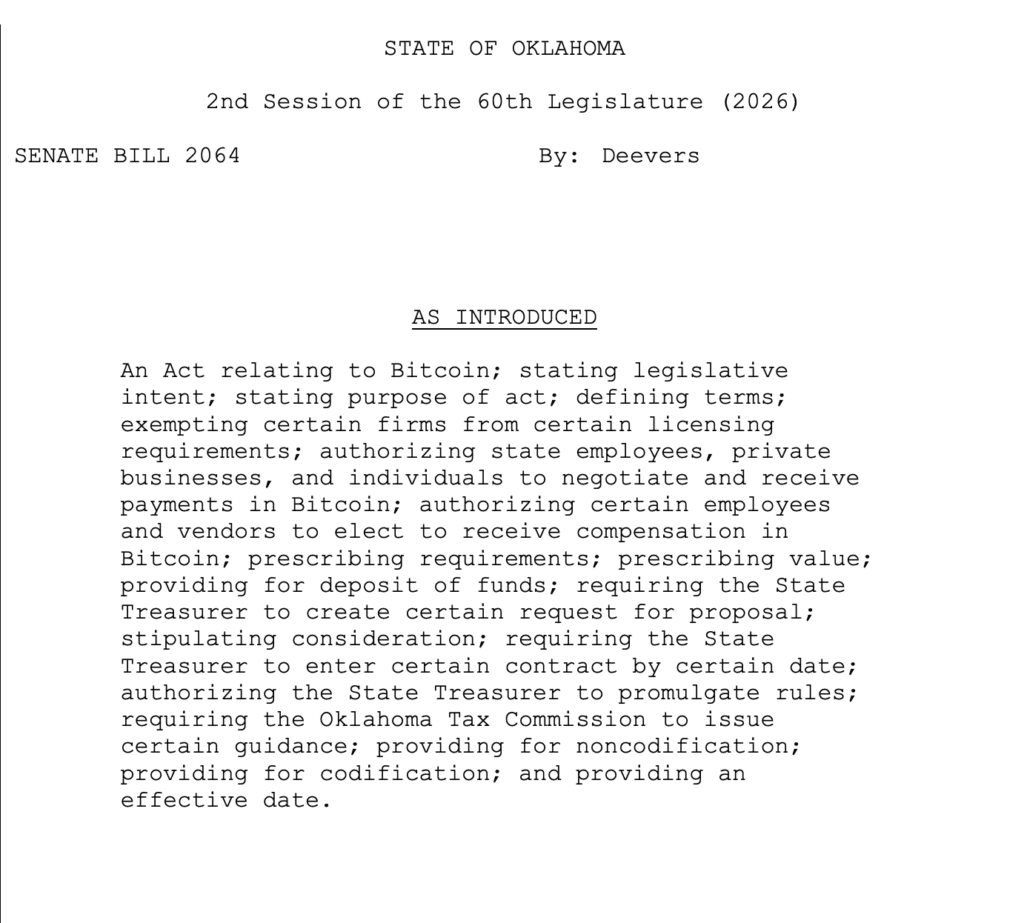
Oklahoma lawmakers introduced a bill this week that would allow state employees, vendors, private businesses and residents to negotiate and receive payments in Bitcoin.
Senate Bill 2064, introduced by Senator Dusty Deevers in the 2026 legislative session, establishes a legal framework for Bitcoin to be used as a medium of exchange and rewards without designating it as fiat currency.
The bill explicitly states that it does not conflict with the U.S. Constitution, which prohibits states from minting money other than gold and silver or declaring it legal tender, and instead recognizes Bitcoin as a financial instrument that operates within the existing legal framework.
If this bill is enacted, Oklahoma state employees will be able to choose to receive their salary or salary in Bitcoin at the start of the pay period or based on the market value of the asset at the time of payment.
Employees can modify their pay preferences at the start of each pay period and can choose to receive compensation in Bitcoin, USD, or a combination of the two.
Payments will be deposited into a self-hosted wallet managed by the employee or a third-party custody account designated by the employee.
The bill also allows vendors who contract with the state to choose to receive payments in Bitcoin on a per-transaction basis. Unless otherwise agreed in writing, the Bitcoin value of such payment will be determined based on the market price at the time of the transaction.
In addition to state payroll and procurement, the bill broadly authorizes private businesses and individuals in Oklahoma to negotiate and receive payments in Bitcoin, strengthening the use of Bitcoin as a voluntary medium of exchange throughout the state’s economy.
SB 2064 includes provisions aimed at reducing regulatory friction for Bitcoin-based businesses. Companies that exclusively trade digital assets and do not exchange them for U.S. dollars would be exempt from Oklahoma’s money transmitter licensing requirements, according to provisions of the law.
The bill directs the Oklahoma State Treasurer to request proposals for digital asset companies to process bitcoin payments for state employees and vendors.
When choosing a provider, treasurers should consider factors including fees, transaction speeds, cybersecurity practices, storage options, and relevant state licenses. The Treasurer must finalize contracts with providers by January 1, 2027, and has the authority to promulgate rules to implement the program.
In January 2025, Oklahoma Senator Dusty Deevers introduced a similar initiative called the Bitcoin Freedom Act (SB 325). This was a bill designed to establish a legal framework for the use of Bitcoin in the state’s economy while allowing employees, vendors, and businesses to voluntarily accept and pay in Bitcoin.
Oklahoma’s Bitcoin adoption mirrors other U.S. states.
The move follows other states such as New Hampshire and Texas that are exploring ways to integrate Bitcoin into public finances.
New Hampshire passed the nation’s first strategic Bitcoin reserve law, allowing the state to hold up to 5% of its funds in high-market-cap digital assets and even approve Bitcoin-backed municipal bonds.
Meanwhile, Texas has combined legislation and action, including establishing a strategic Bitcoin reserve and becoming the first state in the country to purchase nearly $5 million in state Bitcoin ETFs, a hedge against economic volatility and a step toward modernizing the state’s finances.
If passed, SB 2064 would take effect on November 1, 2026, making Oklahoma one of a small but growing number of U.S. states looking to integrate Bitcoin directly into their government payments systems.
The Oklahoma Tax Commission will also issue guidance on the tax treatment of digital assets paid out by January 1, 2027, addressing an area that often creates uncertainty for both employees and employers.