Stablecoins for business payments – Enterprise Ethereum Alliance

At Sibos Frankfurt, the conversation about blockchain-based payments has crossed a clear line.
The conversation shifted from theoretical relevance to practical reality. In other words, how stablecoins and programmable currencies are already being used and what needs to be addressed to operate them safely at scale.
At the EEA x EY side event on Stablecoins in Business Payments, leaders in banking, enterprise software, blockchain infrastructure and regulated wholesale payments compared notes on what is currently working and where real constraints remain.
From ‘eventually’ to ‘right now’
Opening the session, Paul Brody, Global Blockchain Leader at EY and Chairman of the Enterprise Ethereum Alliance, reflected on how quickly long-held assumptions have been shattered.
He expected institutions to start with tokenized assets and later cautiously move to digital currencies. Instead, adoption was reversed. As he said, institutions are now “leading the charge on payments.”
What surprised him was the speed. In his words, the market went from “what might be happening” to “what’s happening right now” in less than a year.
He pointed out that payments are not an isolated function. This is the final step in an extensive transaction process that includes asset delivery, contract terms, and reconciliation. But the industry started with the last mile.
Why banks started with money
This acceleration was consistent with the banking views shared during the discussion.
Naveen Mallela, global co-head of Kinexys at JPMorgan Chase, insisted the focus on payments was intentional. From JP Morgan’s perspective, the real change will be the introduction of a shared, multi-asset programmable ledger into the bank itself.
“Basically, this is introducing a new bookkeeping system for banks,” he explained.
When cash and assets are stored on the same programmable ledger, new capabilities become possible. Naveen pointed to examples such as intraday repos and intraday FX swaps that are changing the way institutions think about short-term liquidity. He emphasized that interoperability will play a crucial role during the long transition period during which on-chain and off-chain systems will have to coexist.
When asked directly about deposit tokens and stablecoins, his answer was practical. Your choice will depend on how it is supported, how it is treated for accounting and tax purposes, and whether deposit style protection is important to a particular customer.
When usability catches up, payments feel real.
While banks focused on balance sheets and interoperability, infrastructure leaders focused on usability.
Guillaume Dechaux, Managing Director of ConsenSys, emphasized that blockchain payments are finally approaching Web2 level experience. “MetaMask is now achieving a Web2 experience,” he said.

Products like MetaMask cards demonstrate this change. Users can spend on-chain assets, sellers can receive local fiat, and conversion is processed at the moment of purchase. As Paul later observed, if users are not aware of whether a service is on-chain or legacy, the conversation about adoption is fundamentally different.
Guillaume also highlighted why payments place such high demands on infrastructure. When financial institutions are involved, predictable finality, throughput, and reliability are not optional.
Where stablecoin use is already a reality
Adi pointed out that while early enterprise blockchain operations often rely on private networks, real-world economic activity continues to gravitate toward public networks. “The value will be in the public networks,” he said. Because public networks have liquidity and interoperability.
Discussing cross-border payments, Adi shared observations from South America that challenge common assumptions. Stablecoin activity there was dominated by remittance-like flows rather than speculation, much of which was driven by businesses rather than retail users.
He also pointed out that stablecoin-based escrow is a simple use case that will become viable once stablecoin rails become available and has clear implications for supply chain payments.
At the same time, the panel acknowledged structural gaps. Small businesses can experiment quickly. Large companies cannot afford regulatory ambiguity.
Wholesale payments are subject to a variety of rules.
Fnality builds a blockchain-based payment system designed for the wholesale market and accepts payments in central bank-grade currencies. Ram emphasized that regulatory standards for systemically important payments infrastructure are very high. “The standards are very, very high,” he said.
Proving resilience, governance, and compliance is slow and expensive. Even as early pioneers help educate regulators, the requirements themselves do not get easier.
Scale only occurs when processes do not change.
Constraints on enterprise adoption were highlighted by Bernhard Schweizer, Head of SAP Digital Currency Hub.
His message was blunt. “Companies cannot change their processes.”
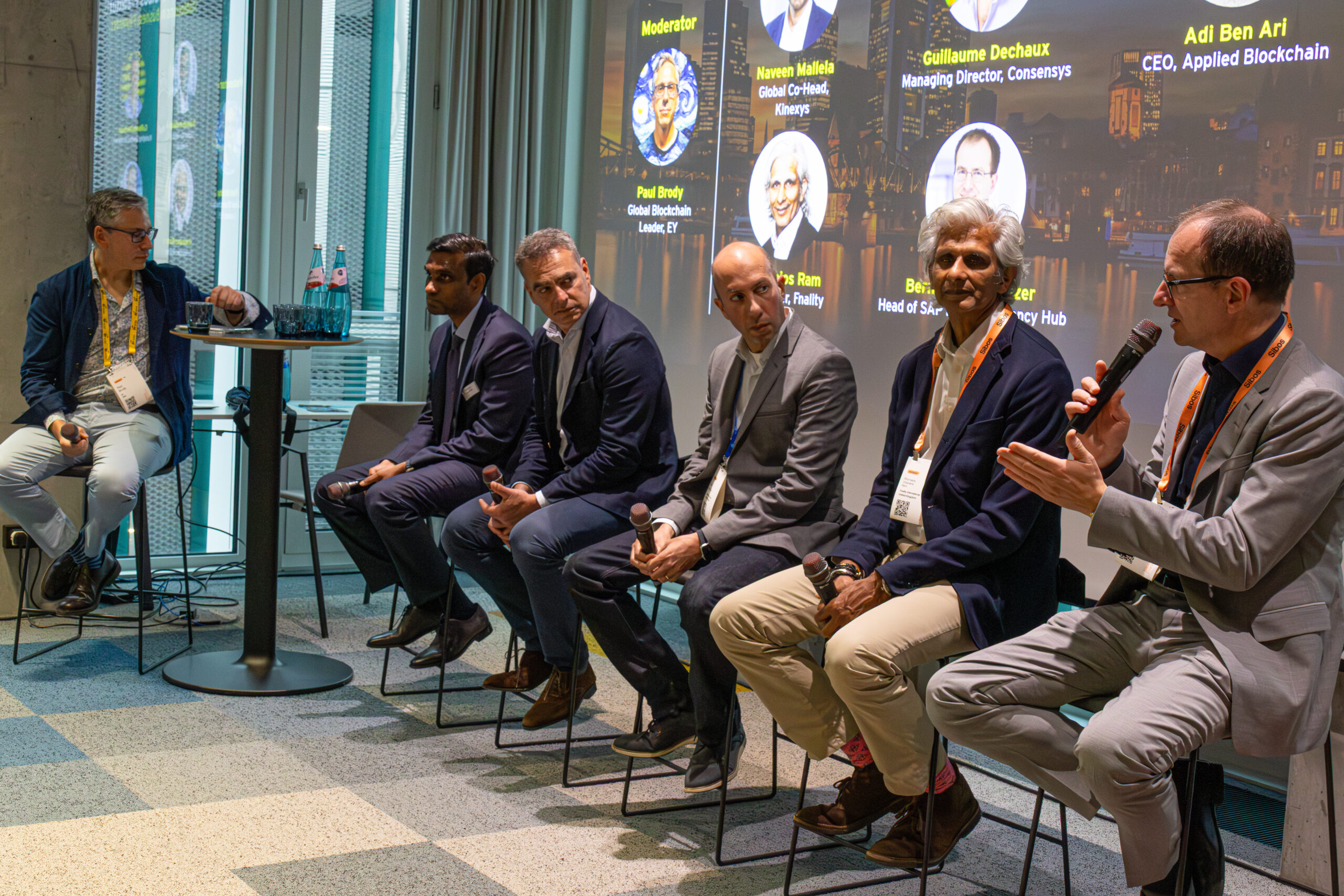
From SAP’s perspective, modern payments rails will only expand as stablecoins, deposit tokens, and bank payments appear as interchangeable options within existing ERP workflows. Companies cannot run separate processes for each rail.
Paul’s experience at EY has reinforced this. It used to be possible to accept stablecoins, but it was operationally painful. Once integrated through SAP’s Digital Currency Hub, it has become the norm rather than the exception.
What comes next?
One thing Sibos Frankfurt makes clear is that business payments are no longer a theoretical blockchain use case. This is the default adoption wedge.
The next step is not to prove that money can move on-chain. This is proof that we can do this with enterprise-grade privacy, regulatory confidence, predictable execution, and seamless integration with the systems companies already run.
That is now the task ahead.