Will the Iran war cause the stock market to crash? 90 years of history is important.

In the long run, Wall Street will arguably become the world’s greatest wealth creator. benchmark S&P 500 (^GSPC 1.33%) It has never decreased in 20 years. Dow Jones Industrial Average (^DJI 0.95%) and Nasdaq Composite (^IXIC 1.59%) It has often tied with the S&P 500 to record highs.
But the stock’s near-term directional movement is much less certain. This is especially true when major geopolitical events are introduced into the equation.

Image source: Getty Images.
On February 28, the US and Israeli forces began military operations against Iran, which clearly sent the stock markets into turmoil. The question on investors’ minds is: Will the Iran war lead to a stock market crash?
Although nothing concrete can be said with certainty, 90 years of history provides valuable insight.
Major geopolitical events can trigger brief periods of panic under certain circumstances.
The past 90 years have seen no shortage of major geopolitical events, including wars, terrorist attacks, assassination attempts on world leaders, invasions, and financial crises. While many of these events have led to emotion-driven trading and increased short-term volatility, stock market crashes have been less common.
But among dozens of major geopolitical events, one variable that has increased the likelihood of a stock market crash is oil. If global energy supplies are at risk of being disrupted or constrained by geopolitical events, there is a greater likelihood of significant stock market declines or short stock market crashes in the near term.
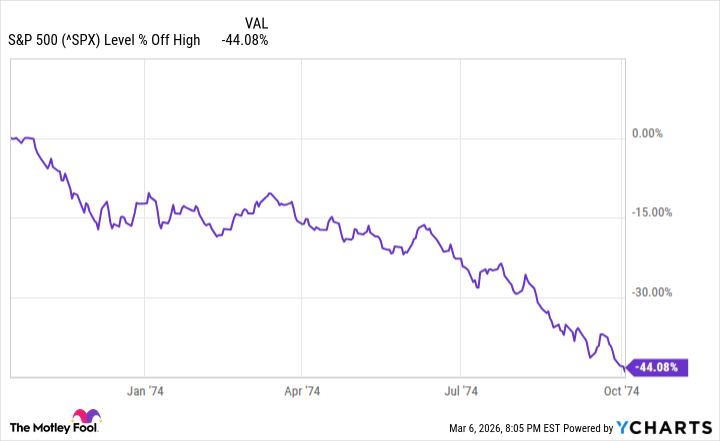
The five-month oil embargo of 1973 wreaked havoc on the stock market. ^SPX data from YCharts. The chart above is from October 16 to October 1973. March 3, 1974.
For example, in the three weeks following Iraq’s invasion of Kuwait in August 1990, the S&P 500 lost 13%. In October 1973, when the Arab members of OPEC banned oil exports to some countries (including the United States) that supported Israel, the S&P 500 lost 17% of its value in less than two months and plunged about 44% in 11.5 months.
If crude oil supply is limited, spot prices may soar. Spot prices for West Texas Intermediate crude surged 36% this week as the war with Iran began and the Strait of Hormuz closed to most oil exports. In addition to rising gas prices, rising fuel prices are known to negatively impact employment and reduce margins in a variety of industries.
While 90 years of historical precedent guarantees nothing, the odds of a crash during an Iran war are higher than those of most other geopolitical events.
The non-linear nature of economic cycles favors long-term optimism.
While history predicts chaos, decades of economic cycle data show how important it is for investors to maintain perspective.
The following is a list of major geopolitical events since World War II.
After six months, the median had increased by 5%. Everyone was in a really bad mood at that time. pic.twitter.com/Jb3QXL0L05
— Ryan Detrick, CMT (@RyanDetrick) February 28, 2026
The S&P 500 is up 65% in the year since the start of a major geopolitical event since World War II, according to data compiled by Ryan Detrick, chief market strategist at the Carson Group. Although the average annual return of 3% was subpar, optimism still more often than not prevailed when compared to the long-term annual returns of the stock market.
Moreover, according to data from Bespoke Investment Group, the average bear market decline (more than 20%) in the S&P 500 has cleared 286 days since the start of the Great Depression (September 1929). Meanwhile, the typical S&P 500 bull market lasted about 3.5 times longer (1,011 days).
If the Iran war causes a crash, history suggests it will be short-lived and a buying opportunity for opportunistic long-term investors.