From T+1 to T+0: What happens as the chain progresses after a transaction (Stable Summit New York Fireside Summary)
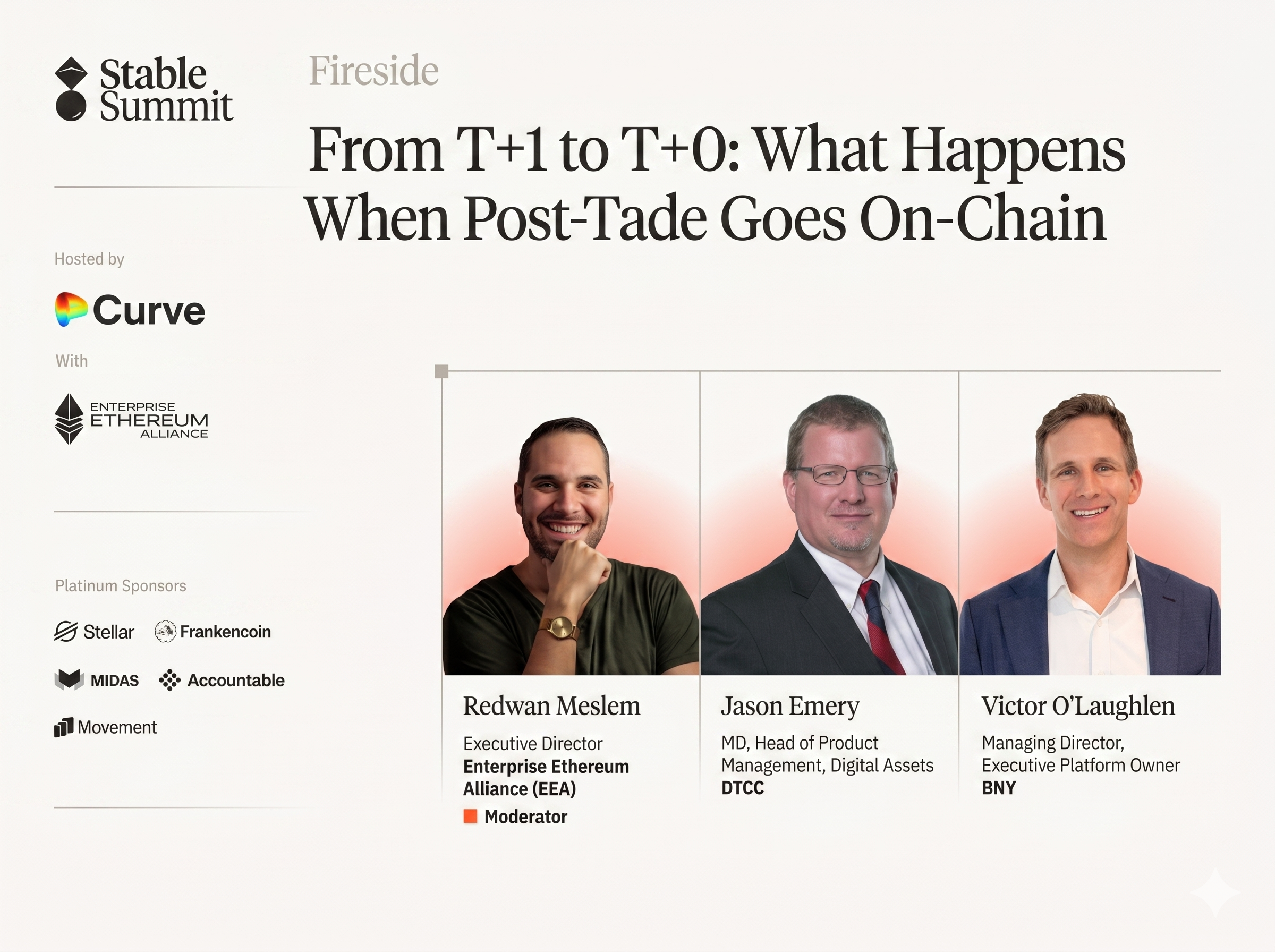
Recently stable summit In a fireside session, industry pioneers came together to move beyond abstract blockchain theory and address the immediate operational realities of institutional deployments. Hosted by: curve The following Platinum Sponsors are featured: major, frankencoin, midas, responsibleand movementThe panel was moderated by Redwan Meslem, Executive Director of the EEA.
He worked with Jason Emery (MD, Head of Digital Asset Management Products at DTCC) and Victor O’Laughlen (Managing Director, Platform Owner, BNY) to map the technology and business changes needed as post-trade settlement architectures move natively on-chain.
The consensus of the conversation was absolute. Asset tokenization is no longer an engineering hurdle. Modern bottlenecks are fully operational. For distributed ledgers to handle the speed of institutional capital networks, market participants will need to figure out how to operationalize on-chain assets within traditional risk, compliance, and back-office ledger management frameworks.
Moving beyond idle tokens to active collateral mobility
The digital asset industry has proven that it is possible to wrap real-world assets into tokens, but simply moving the security to a distributed ledger is inherently unable to realize commercial value. If tokenized assets sit idle in wallets without liquidity or utility, they add absolutely no efficiency to a company’s balance sheet. The real value driver is collateral portability – the ability to seamlessly collateralize, transfer and liquidate assets to meet real-time margin requirements.
Traditional clearing and custody giants are approaching this challenge by embedding institutional protections directly into the tokenization layer. The goal is to extend the trusted payment rules of traditional finance to a programmable environment.
“The asset itself being a token doesn’t create a huge amount of value. The reality is that the use cases on the chain are what will create the value. I think getting assets onto the chain and then actually creating value through use cases like collateral portability is where we need to get to.” — Jason Emery, DTCC
To achieve this, infrastructure providers are designing networks that maintain full legal continuity. For example, DTCC’s tokenization framework is built to ensure that on-chain tokens have the same legal rights as holding assets in their traditional form. This enables seamless two-way conversion between tokenized and legacy formats, allowing institutional traders to instantly re-leverage large legacy liquidity pools when fast-moving market events occur.
Overcome the risk limits of 24/7 operation
Tokenization essentially enables continuous, 24-hour payments, but at the same time introduces significant structural friction into existing corporate banking systems. Traditional financial institutions, broker-dealers and vendor clearing platforms are not designed to manage credit exposures, asset valuations and process compliance flags 24/7.
Shifting from human-controlled settlement cycles to automated, instant execution requires a complete overhaul of enterprise risk operating models. If institutions cannot support a continuous “always-on” global team to manage automated margin calls, then a 24/7 on-chain market becomes a disadvantage rather than an advantage.
“Can they perform clearing, settlement, reporting and compliance 24/7? If you ask any vendor that does clearing and settlement for the largest dealers in the market, if they are available 24 hours a day, they will tell you no… Operationally, there are efficiencies to be gained through tokenization, but from a risk management perspective, there is a lot to unpack for the institution.” — Victor O’Laughlen, BNY
Additionally, large market participants require absolute legal finality. In a traditional financial ecosystem, clearinghouses and third-party clearing agents step in to absorb counterparty risk and immediately resolve transaction failures. If a tokenized asset is re-collateralized multiple times over an open network and the counterparty defaults, the underlying system must be able to cancel that transaction immediately. Institutional clients cannot afford to secure critical operating liquidity due to multi-year bankruptcy workouts.
The way forward: operating trust at scale
The transition to automated collateral management requires systematic coordination between technology providers, market holders and regulators. The industry has the encryption tools needed to secure high-speed networks. The challenge is to adapt business operations to safely accommodate this.
Existing infrastructure players will be responsible for driving this integration. By running controlled production pilots within a secure enterprise network, market leaders can demonstrate real-world resilience to regulators while establishing a clear template for client onboarding.
Ultimately, unlocking trillion-dollar liquidity pools for corporate treasuries requires acknowledging that incremental savings in on-chain transactions are meaningless if the system introduces unmanaged downside risk. Collateral is the lifeblood of institutional markets. Scaling tokenized capital is not a matter of blindly trusting native code, but of using immutable, open network standards to solve old operational problems in entirely new ways.
Key takeaways for financial leadership
- Prioritize collateral utility: Shift your digital asset strategy from passive asset tokenization to active on-chain collateral mobility and liquidity integration.
- Bridge Legal Framework: All tokenized asset placements maintain absolute legal symmetry with traditional securities, ensuring investor protection and smooth liquidity transition.
- Ongoing operational readiness: Before connecting to automated on-chain payments or settlement networks, evaluate your internal back-office, risk and compliance systems for the scope of 24/7 operations.
- Insist on clarity from the other person. It requires a clear and ironclad legal framework that defines asset ownership, re-collateralization rules, and liquidation procedures in the event of a default by a network counterparty.