Additional Information for Passing or Break-Even EAs – Miscellaneous – April 1, 2026

More about Pass or Break Even EAs
This page covers complete technical details, background, life cycle mechanisms, live test results, notes and disclaimers for the Pass or Breakeven (POBE) Expert Advisor listed on the MQL5 Marketplace.
View/Back to product list | Backtest/Simulator Guide
The idea behind POBE
Published industry data covering over 300,000 prop company accounts suggests that approximately 1 to 2 percent of all challenge buyers receive a funding account payout. For the remaining 98-99%, the challenge fee will not be refunded if the challenge fails.
POBE changes this structure. The broker account remains in opposition throughout the challenge, so every possible life cycle exit produces a defined outcome. Six endings are possible over three stages. Based on the observed challenge cycles, the three final outcomes were distributed as follows:
- Approximately 50% of the observed challenges ended near the break-even point. In other words, it ended in either stage 1 failure or funding stage failure. The broker account recovered an amount close to the challenge fee.
- Approximately 25% of the observed issues passed stage 1 but failed stage 2, ending with a net positive result. The broker account accumulated profits in both stages.
- Approximately 25% of observed issues ended up being funded. You passed all the steps and received your funded account profit sharing.
These numbers are based on observed challenge cycles and vary depending on the trader, strategy and market conditions. This is for reference purposes only and is not a guarantee of future results.
Traders running POBE do not need to pass challenges to get results. Rather than a binary fee at risk, the challenge fee becomes a capital deployment with a defined expected outcome across all possible pathways.
background
Published industry data, which includes over 300,000 prop firm accounts across multiple companies, shows that around 14% of traders pass the second stage 1 assessment and around 1-2% of all challenge buyers receive a funded account payout. Several independent sources quote an overall assessment pass rate of 5 to 10 percent.
Researchers and trading psychology experts consistently identify emotional factors, including fear, impulsive recovery trading after a loss, and pressure to meet goals before commission renewals, as the main reasons why traders fail to evaluate rather than fail a strategy. A trader under evaluation pressure will behave differently than a trader on a demo account, even if they use the same settings.
POBE solves this problem by removing manual decision-making from the process. EA executes trades according to configured parameters without reacting to stock movements, proximity to downside, or proximity to targets.
How the Hedge Lifecycle Works
POBE tracks three stages that correspond to a standard two-stage prop company structure: Stage 1 (Challenge), Stage 2 (Validation) and Funding Stage. At each stage, the Prop Company account and Broker account occupy opposing positions. When one account profits, the other account loses a proportional amount determined by the hedge ratio.
The four possible life cycle ends are:
- Failure Stage 1 — The prop company has reached maximum attrition. The broker collects counter profits with the goal of recovering the challenge fee.
- Stage 2 Failed – The prop company passed Stage 1, but reached maximum attrition during verification. The broker accumulated profits in both stages, resulting in a net positive result in the observed tests.
- Failed funding phase — the prop company passes both phases but reaches maximum decline after receiving funding. The broker’s profits from both evaluation stages offset the losses from the funding stage, aiming to break even.
- Passed the funding phase – The prop company has met its funding revenue target. Broker losses across all three stages are offset by funds disbursement and commission refunds. This is the maximum outcome of the life cycle.
Many traders assume that once steps 1 and 2 have been passed and a funded account has been secured, POBE’s work is done. This is a common misconception. Passing stages 1 and 2 means that your broker account has maintained a contrarian position through both evaluation stages and has accumulated sunk costs. The funded phase is the phase in which sunk costs are recovered either through a funded gain where they are fully offset, or through a funded breakeven point where the life cycle ends with no net loss. Running the funding phase through POBE is not optional. This is the final step in completing the hedge. Without this, broker sunk costs remain unrecovered at both valuation stages.
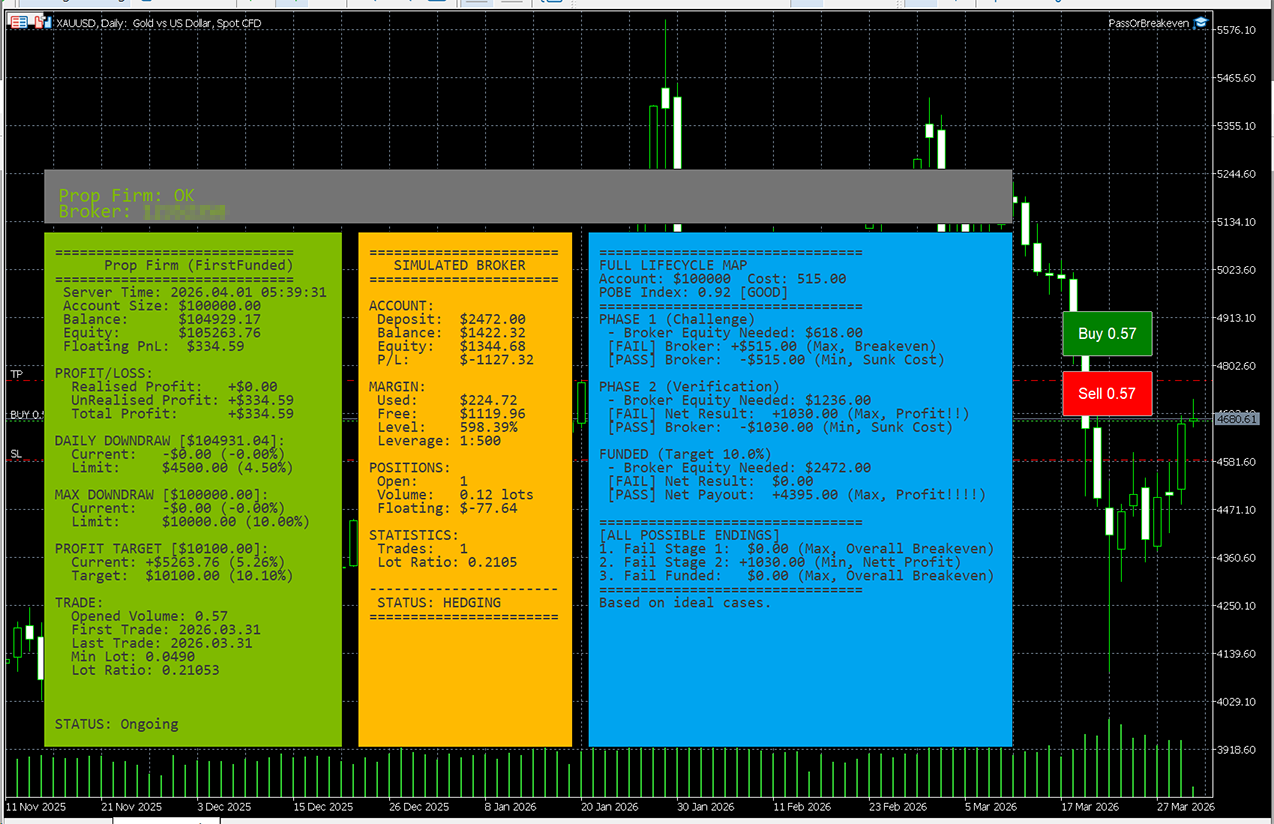
POBE Index
The POBE index measures how challenge fees compare to the maximum amount that can theoretically be returned during the funding phase after payment splitting. The smaller the fee compared to the potential funding payout, the higher the index. The larger your account size or lower the challenge fee, the better your index will be. The rating is displayed on the chart.
- Very Good — Fees are very small compared to potential return on funds.
- GOOD — Configuration is suitable for hedging
- Average — Hedging is feasible, but the margins are moderate.
- WEAK — Fees will be relatively higher, but consequences will be more stringent.
- Not suitable — EA does not recommend proceeding as the fees consume too much of the potential return on funds.
Run the backtest simulator before starting the live challenge. Before you begin, check the POBE index and required capital figures for your specific account size and challenge fee.
Built-in backtest simulator
The demo version runs in MT5 Strategy Tester with simulated broker mode enabled. The EA will run a full challenge simulation, including reaching the configured profit target or violating the drawdown limit, just like in a live challenge. The simulated broker tracks opposing positions throughout and displays balances, assets, and execution results on charts along with prop company accounts. A life cycle map display and POBE index are shown throughout the test.
We run the tests multiple times over different date ranges to observe both pass and fail results and verify life cycle map calculations for our own prop company’s parameters.
The simulator panel explained:
- Green panel — Prop company account. Displays balance, equity, loss, profit target progress and current trading statistics.
- Yellow panel — Simulated broker account. Track internal hedge calculations including deposits, balances, equity, open positions, lot ratios and margins. No actual second account is required during backtesting.
- Blue panel — Full life cycle map. It displays the POBE index, assets required per stage, expected outcomes at each possible exit, and a summary of all possible life cycle outcomes.
Real-time test results
All six lifecycle paths were observed in real-time testing on a $100,000 FTMO account. Results are shown net of all broker fees, challenge fees, spreads, slippage, funded account payouts and commission refunds where applicable. Most results arrived within 97-99% of the calculated theoretical values shown in the life cycle map display.
Pass the challenge (level 1)
Challenge Failed (Level 1)
Confirmation of passing (step 2)
Check for failure (step 2)
Pass Funding (Tier 3) — Run 1 time
Pass Funding (Phase 3) — Run 2
Failure to Raise Funding (Step 3)
Results may vary due to actual hedging frictions due to spreads, slippage and swap fees. In trending market conditions where fewer transactions are required to reach the stage target, hedging fidelity is tighter and results are closer to the lifecycle map values. Wide or uneven conditions create more friction over a longer period of time, and ongoing challenges with more transactions accumulate more friction on both accounts.
memo
- Choosing a broker is important. Use a low-cost broker with tight spreads and fast execution speeds. High spread or slow execution increases the gap between the two accounts and reduces how closely the actual results match the lifecycle map values.
- Applies to level 2 challenges only. POBE does not consist of a one- or three-stage evaluation structure without parameter adjustments.
- Both terminals must remain active. If one terminal is closed or disconnected, transaction copying is paused until the connection is restored.
- One instance per machine. POBE is designed to run one instance per VPS or PC, ensuring that no two challenges share the same IP address at the same time.
- Broker account funding. If your broker account balance falls below the required asset figure for the current step, the EA will display a warning and pause the opening of trades. Required asset figures are shown on the lifecycle map display and include safety buffers.
- Offers compliance with company rules. It is your sole responsibility to ensure that your chosen prop company allows this approach prior to use. Prop company rules vary and may change at any time.
- Manual and third party EA transactions. POBE hedges all open positions in Prop firm accounts, including positions opened manually or by other EAs. Trades not opened with POBE use less accurate lot ratios and are hedged with lower fidelity than trades opened with POBE.
- MT4 version will be released soon. The current version is only for MT5. Cross-platform pairing between POBE MT4 and POBE MT5 will be supported once the MT4 version is released.
Disclaimer
Results are not guaranteed. Past performance, real-time test results and theoretical life cycle calculations shown on this product do not guarantee future results. Trading involves significant risk. Results shown in the Lifecycle Map display are based on ideal conditions and may differ from actual results due to spreads, slippage, swap fees, execution delays, broker rejections, connection outages and other practical factors. Actual results may differ significantly from the theoretical values shown.
We offer company payment. Developer has no control over and is not responsible for Prop Company’s decisions to pay, withhold, delay or deny funded account profits. Prop companies are independent third party companies. Payment policies, withdrawal terms, account terms and ongoing operations are entirely beyond the control of the Developer. User selects a reputable prop company and assumes full responsibility for all financial consequences arising from the prop company’s actions or inaction.
There is no financial advice. This EA is a software tool. Nothing in this product, its documents or related communications constitutes financial advice, investment advice or trading recommendations. You are solely responsible for all trading decisions and for ensuring that this tool is appropriate for your personal circumstances and risk tolerance.
Risk of Loss. Trading foreign exchange and related products involves a high degree of risk and may not be suitable for all investors. The use of automated trading software does not reduce or eliminate these risks. You may lose some or all of your invested capital. Don’t trade with money you can’t afford to lose.
Software limitations. This EA is provided AS-IS. Although every effort has been made to ensure reliable operation, the Developer does not warrant that the Software will be free from errors, bugs or interruptions. The developer is not responsible for any losses arising from software malfunctions, incorrect configuration, unexpected broker or platform behavior.
Third Party Platforms. This product is registered and distributed through MQL5.com. MQL5.com is a third party marketplace and is not affiliated with or responsible for any of the features of this EA, the actions of prop companies, or the financial consequences of using this product.
A two-terminal hedged EA for two-stage prop company problems. The broker account’s opposing positions produce calculated results for all four possible life cycle outcomes.
Back to product description | Backtest/Simulation Guide