Amazon’s push for rapid delivery has resulted in $15 billion losses for Eternal and Swiggy.
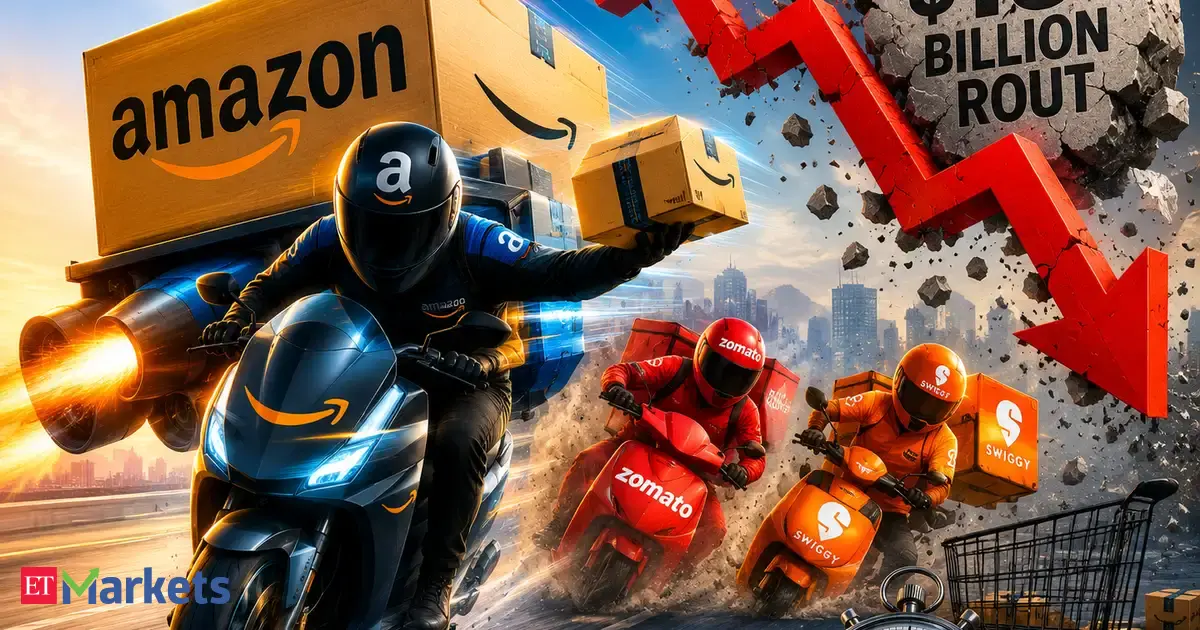
Eternal, which operates Blinkit, which delivers everything from eggs to electronics to your doorstep in minutes, was down 28% from its October all-time high as of Thursday’s close, while rival Swiggy, owner of Instamart, was down about 47% from its recent September high. The duo faces a sell-off of more than $15 billion (Rs 1.4 billion) as investors get spooked by the onslaught of competition.
Amazon and Flipkart are doubling down on India’s fast-growing $11 billion rapid commerce sector, expanding into smaller cities by creating a network of last-mile warehouses called dark stores. Meanwhile, Zepto Ltd. plans to raise up to $1 billion through an initial public offering (IPO) to raise funds to take on market leaders Blinkit and Swiggy Instamart.
 bloomberg
“The challenge now is that competition is very fierce, which reduces short-term profitability,” Yi Ping Liao, a Franklin Templeton fund manager who holds Eternal shares, said in an interview. “The risk is the duration of competitive intensity.”

Seattle-based Amazon, which launched ultra-fast delivery last year, is making up for its delayed entry. Last week, Amazon announced plans to expand its Amazon Now service to more than 300 cities and towns, up from more than 15 currently, while pledging to invest another $13 billion to build AI and cloud infrastructure in India.
According to a report in The Economic Times, Flipkart Minutes expanded to 1,000 dark stores within two years, serving 130 cities within two years. Flipkart plans to open 1,500 stores in over 180 cities in the coming months, the report said.
“Based on store expansion and aggressive discounts proposed, we believe Amazon will snatch some market share from the incumbents,” said Rashi Talwar Bhatia, chief investment officer at Ashmore Investment Management India LLP, which holds Swiggy shares due to the discounted valuation.
Blinkit had 2,243 dark stores in the fiscal year ended March 31, with Swiggy lagging behind with 1,143, according to a May 15 report by Macquarie Equity Research.
Billionaire Mukesh Ambani’s conglomerate is leveraging Reliance Retail Ltd.’s extensive network of offline stores to drive faster commerce across categories under its JioMart platform. Its network of more than 3,100 stores serves more than 1,200 cities, Reliance shareholders said at its annual general meeting earlier this month.
‘Yearly, not quarterly’
“We see competitive intensity continuing to rise across multiple dimensions, not just quarters, but years,” including omnichannel retail and horizontal e-commerce platforms like Amazon Now and Flipkart Minutes, Macquarie analysts Aditya Suresh and Baiju Joshi wrote in a May report.
The brokerage lowered its price targets for Eternal and Swiggy and downgraded Swiggy to Underperform. Eternal already has an Underperform rating.
Excitement surrounding Zepto’s expected listing next month has subsided as the competitive moat surrounding the two large quick commerce incumbents has narrowed. Founded by two Stanford dropouts in 2021, 10-minute delivery in India has been Zepto’s idea for the local market from the beginning.
But it is coming to the domestic stock market just as its deep-pocketed rivals are working on one of the world’s most closely watched rapid delivery experiments.
In the unlisted markets, Zepto’s share price has fallen over 32% since February, falling from Rs 58 to Rs 39, according to data from UnlistedZone.com.
price war
While Blinkit showed Ebitda-level profitability in the December quarter, Swiggy’s faster commerce operations resulted in a loss of about $460 million for the year and Zepto lost more than $600 million.
Blinkit’s representative believes that the sector can succeed even as it undergoes major changes, and Swiggy has promised not to engage in such price wars. Franklin’s Liao expects Blinkit’s superior unit economics and execution capabilities to help it compete.
However, competition is not decreasing and is instead going all-in for market share and taking deep discounts.
bloomberg
The upside is that the surge in demand has shifted decisively beyond metros to Tier 2 and Tier 3 cities. This highlights how the fast commerce model has pan-India appeal, Emkay analysts led by Pranav Kshatriya wrote in a June 14 report.
However, this trend does not hinder the fierce competition in the rapid delivery sector.
“The sector is still in a monopoly phase and competition will continue to increase with the entry of Amazon and Flipkart,” Emkay’s report said.