Antminer S21 XP vs S23: Ultimate Efficiency Guide

SUMMARY
If you’ve been shopping for a new Bitcoin miner in 2026, chances are the Antminer S21 XP and Antminer S23 are both on your shortlist. That’s a good problem to have. S21 XP vs S23, both are strong performers built on Bitmain’s SHA-256 architecture. But they serve different mining profiles, and buying the wrong one for your situation can hurt your profitability for years.
The short version: the S21 XP is the more accessible, budget-friendly choice with a proven track record and solid 13.5 J/TH efficiency. The S23 is the newer, more powerful machine with best-in-class 11 J/TH efficiency, but at a price that’s more than double. In this guide, we’ll break down both miners completely so you can make the call with confidence.
It’s also crucial to know the implications of what you’re purchasing. In April of 2024, the Bitcoin reduction in the block’s value by 6.25 BTC to 3.125 BTC, which squeezed margins everywhere and pushed more inefficient, older equipment into insolvency. Machines with 20-25 J/TH are getting decommissioned in huge numbers. Both S21 XP and S23 sit just below the threshold, which means they are functional; the gap in efficiency between them has significant financial implications on the scale of monthly electric bills. Understanding the implications of this is precisely what this guide was created to aid in.
Quick Side-by-Side Specs Comparison
| Feature | Antminer S21 XP | Antminer S23 |
| Algorithm | SHA-256 | SHA-256 |
| Hashrate | 270 TH/s | 305 TH/s |
| Power Consumption | 3,645W | 3,355W |
| Energy Efficiency | 13.5 J/TH | 11 J/TH |
| Noise Level | 76 dB | 76 dB |
| Cooling | Air (4 fans) | Air (4 fans) |
| Net Weight | 18.7 kg | 20.6 kg |
| Dimensions | 449 × 219 × 293 mm | 450 × 219 × 293 mm |
| Voltage Input | 220–277V | 220–277V |
| Interface | Ethernet | Ethernet |
| Operating Temp. | -20°C to 45°C | -20°C to 45°C |
| Warranty | 365 Days | 365 Days |
| Price | $3,899 | $8,349 |
The numbers tell a clear story. The S23 produces more hash and does it with less electricity. The S21 XP costs far less upfront and still delivers respectable efficiency. Both are strong; the right pick depends entirely on your scale and capital situation.
Antminer S21 XP: Key Specs and Features
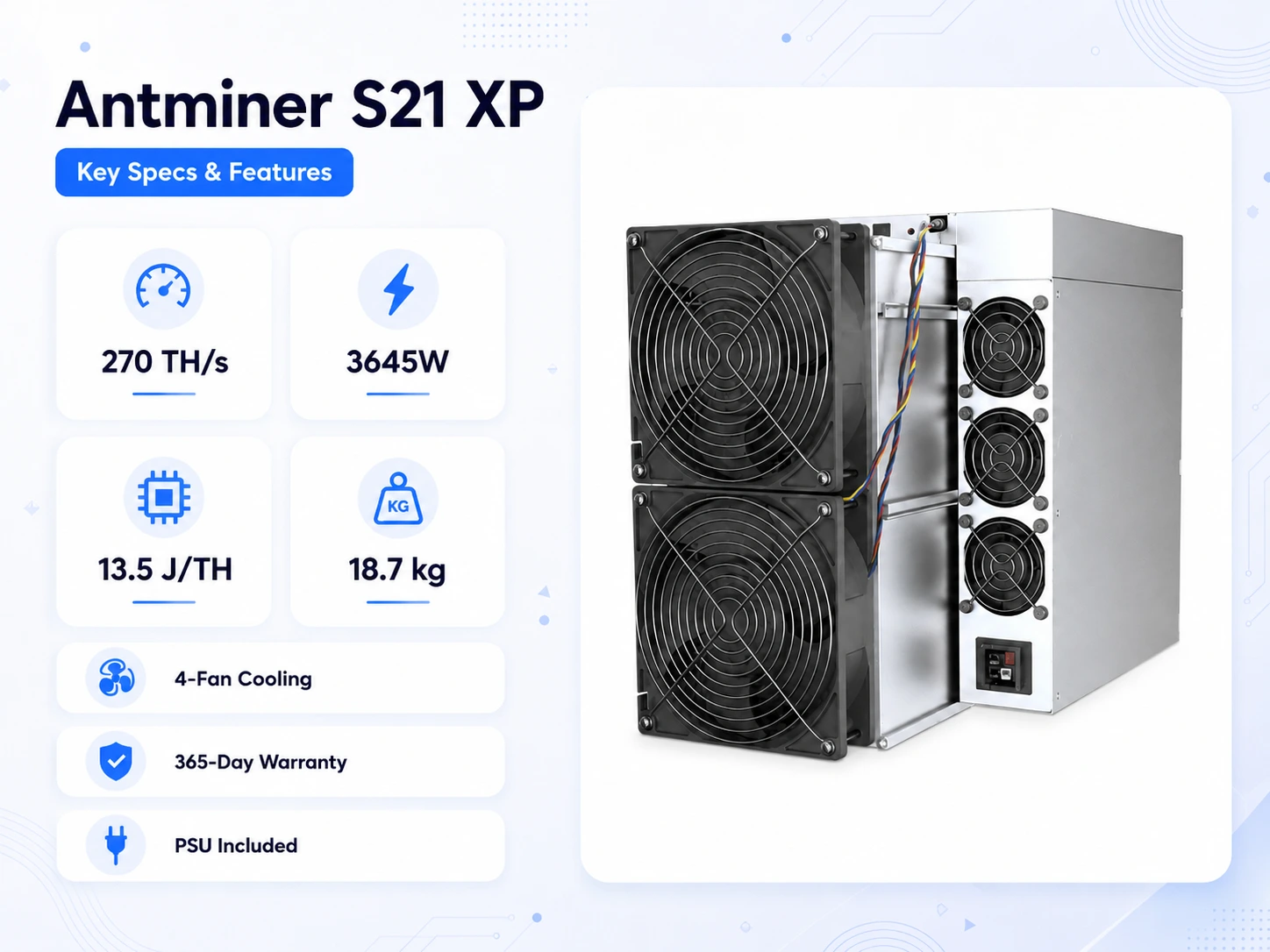
The Bitmain Antminer S21 XP delivers a maximum hashrate of 270 TH/s at 3,645W, giving it an energy efficiency of 13.5 J/TH. For an air-cooled ASIC miner at under $4,000, that’s a genuinely competitive figure in today’s market.
Standout Features
- 270 TH/s hashrate: among the highest output available in the sub-$4,000 price tier
- 13.5 J/TH efficiency: keeps operating costs manageable for small-to-mid scale farms
- Four-fan air cooling: no liquid cooling infrastructure required, lowering setup costs
- 18.7 kg net weight: manageable for standard rack setups
- 365-day warranty: full manufacturer coverage included
- PSU included: no additional power supply purchase needed
Its S21 XP is well-suited for users who require a high-performance machine without the high price of high-end hardware. Its lower initial cost results in a shorter break-even time, which is crucial when capital is scarce, and you need to earn returns faster rather than later.
The feedback of buyers from real-world experience consistently emphasises smooth setup, reliable performance straight out of the factory, as well as reliable long-term performance. The web-based dashboard of the machine is simple and clean to navigate, offering live information on the speed of your fan, hashrate temperatures and pool connectivity, without the need for third-party monitoring software.
If you’re constructing your first farm or expanding an existing small-scale operation, the S21 XP is a proven and lower-risk investment which provides an effective hash without the need for the same level of facilities or capital.
Antminer S23: Key Specs and Features
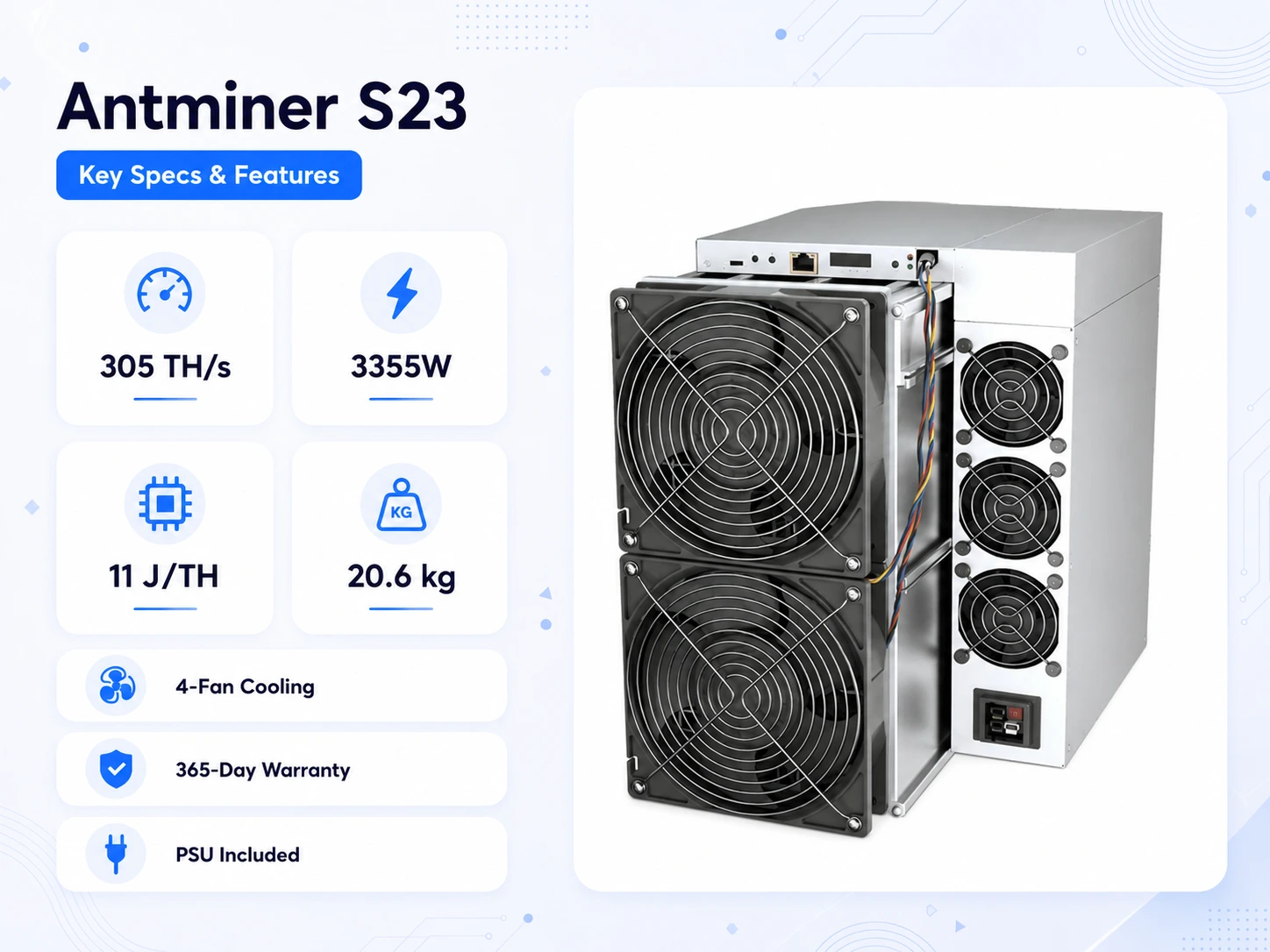
The Bitmain Antminer S23 is Bitmain’s latest-generation flagship SHA-256 bitcoin miner, delivering 305 TH/s at just 3,355W, with an efficiency rating of 11 J/TH. That means it produces more hash while consuming less electricity than the S21 XP, which is the hallmark of a genuine next-gen chip design.
Standout Features
- 305 TH/s hashrate: top-tier output for an air-cooled production machine
- 11 J/TH efficiency: one of the best efficiency ratings in air-cooled SHA-256 hardware today
- Four-fan air cooling: handles industrial workloads without liquid cooling infrastructure
- 20.6 kg net weight: similar rack footprint to the S21 XP
- 365-day warranty: full manufacturer coverage included
- PSU included: ready to plug in and run
The S23 is engineered for operations where electricity cost is the central variable and long-term efficiency is the priority. The 11 J/TH rating means it tolerates higher electricity prices while still staying profitable, giving it a longer operational runway than the S21 XP as network difficulty continues to rise. It also means that on hot days or in warmer climates where heat-related throttling can reduce effective output, the S23’s lower base power draw gives it an inherent thermal advantage.
At $8,349, it’s a serious capital commitment, but for high-volume farms running units for two or more years, the compounding electricity savings and higher daily earnings make it the stronger long-term bet. For buyers who plan to HODL their mined BTC rather than sell immediately, the S23’s efficiency edge becomes even more valuable over time as the portfolio builds.
Efficiency Deep Dive: Why J/TH Is the Number That Matters Most
In 2026’s mining environment, post-halving, with the block reward locked at 3.125 BTC and the global network hashrate above 800 EH/s, your profitability is almost entirely determined by how much electricity you spend per terahash. Revenue per unit of hash is set by the market. Your electricity cost per terahash is something you can control through smart hardware choices.
Here’s what the efficiency difference looks like in practice at $0.07/kWh (live data from the Crypto MinerBros product calculators):
| Metric | S21 XP | S23 |
| Daily power cost | $6.12 | $5.64 |
| Annual power cost (1 unit) | $2,234 | $2,059 |
| Annual electricity savings (S23 vs S21 XP) | — | ~$175/unit |
| Savings across 100 units | — | ~$17,500/year |
At a small scale, $153/year per unit is a modest difference. At 100 or 500 units, it’s a meaningful operational advantage that compounds every single year the machines run.
The S23 also has a higher breakeven electricity rate, meaning it stays profitable at power costs where the S21 XP would start losing money. This makes the S23 a better fit for miners who don’t have locked-in sub-$0.05/kWh contracts and need a buffer against rate fluctuations.
Profitability: Live Calculator Data and Full Analysis
This is the section that actually decides the purchase for most miners. Let’s go beyond a single number and look at profitability from every angle, daily, monthly, yearly, at different electricity rates, and at different operational scales.
Base Profitability at $0.07/kWh
The figures below are pulled directly from the Crypto MinerBros mining profitability calculators on each product page, not estimates, not projections.
| Metric | S21 XP (270 TH/s) | S23 (305 TH/s) |
| Daily Income | $7.63 | $8.94 |
| Daily Electricity Cost | -$6.12 | -$5.64 |
| Daily Net Profit | $1.50 | $3.31 |
| Monthly Net Profit | $45.05 | $99.25 |
| Yearly Net Profit | $548.06 | $1,207.55 |
| Hardware Cost | $3,899 | $8,349 |
At $0.07/kWh, the S23 earns more than double the daily profit of the S21 XP, $3.31 versus $1.50. That yearly gap of roughly $659 per unit is significant. It also means that despite the S23’s much higher price tag, it generates more income every single day, which matters for cash flow and long-term ROI.
How Electricity Cost Changes Everything
Your electricity price is the biggest factor in the mining profit. practical tips you can apply in everyday life. From boosting confidence, how these miners perform in three typical power-cost scenarios:
| Electricity Rate | S21 XP Daily Profit | S23 Daily Profit | S23 Advantage |
| $0.05/kWh | $3.94 | $5.56 | +$1.62/day |
| $0.07/kWh | $1.50 | $3.31 | +$1.81/day |
| $0.09/kWh | -$0.94 | $1.06 | S21 XP at a loss |
A few things stand out immediately. At $0.05/kWh, typical for miners with subsidised or industrial power, both units generate solid margins. At $0.07/kWh, both remain profitable, but the S23’s advantage becomes more pronounced. At $0.09/kWh, the S21 XP goes underwater while the S23 still holds a thin positive margin. This is why efficiency isn’t just a spec number; it’s the margin of survival when electricity costs rise or Bitcoin price dips.
Profitability at Scale: 10 Units vs 50 Units
Individual unit numbers are useful, but most serious mining operations are thinking about fleets. Here’s what profitability looks like when you scale up, at $0.07/kWh:
| Scale | S21 XP Monthly Profit | S23 Monthly Profit | Difference |
| 10 units | $450.50 | $992.50 | +$542/month |
| 25 units | $1,126.25 | $2,481.25 | +$1,355/month |
| 50 units | $2,252.50 | $4,962.50 | +$2,710/month |
| 100 units | $4,505.00 | $9,925.00 | +$5,420/month |
At 50 units, the S23 fleet actually earns $2,710 more per month than a comparable S21 XP fleet. Over a year, that comes out to $32,520 of extra profit, which is a figure that starts to honestly justify the higher upfront hardware cost. At 100 units, the annual gap is over $65,000, no question.
This is why big operations tend to gravitate toward the most efficient hardware they can, because that efficiency premium basically pays itself back through compounding daily earnings, not merely electricity savings or some narrow cost thing.
ROI Comparison: When Do You Get Your Money Back?
Return on investment depends on both daily profit and hardware cost. Here’s the simple math at $0.07/kWh using the live calculator figures:
- S21 XP: $3,899 ÷ $45.05/month = approximately 86 months (~7.2 years)
- S23: $8,349 ÷ $99.25/month = approximately 84 months (~7 years)
Interestingly, at $0.07/kWh, the break-even timelines are nearly identical because the S23’s higher daily earnings roughly offset its higher price. At cheaper electricity rates where both units earn more, these timelines compress significantly. At $0.05/kWh, for example:
- S21 XP daily profit: ~$3.94 → monthly ~$119.70 → break-even ~33 months
- S23 daily profit: ~$5.56 → monthly ~$169.07 → break-even ~49 months
At cheap power, the S21 XP actually breaks even faster due to its lower price, but the S23 generates more total profit over the full operational life of the machine.
What Else Affects Your Profitability?
A few variables beyond electricity cost that every miner should factor in:
- Bitcoin price: Both calculators are based on current BTC prices. A 20% move in either direction directly changes your daily income by 20%.
- Network difficulty: As more miners join the network, difficulty rises, and your share of the daily 450 BTC reward shrinks. Top-tier efficiency hardware like these units is the best hedge against rising difficulty.
- Pool fees: Most major pools charge 1–2%. At $0.07/kWh, that’s roughly $0.09–$0.18/day on the S23, small but worth factoring into your monthly math.
- Choice of mining pool: FPPS and PPS+ pools will include transaction costs in your payments, which could generate significant earnings on days when Bitcoin mempool activity is at a high.
- The longevity of the hardware: Each unit comes with a 365-day guarantee. Properly maintained machines in climate-controlled settings generally last for 3 to 5 years. The longer your hardware lasts, the better your overall ROI appears.
At $0.07/kWh, the miners are both earning money at present. S23 is the more profitable one. S23 earns more every day, per month, as well as per year. That advantage increases in value as the years progress. S21 XP offers a lower starting cost and has nearly the same break-even times at the current electricity rate, making it a sensible option for those with capital as the primary limitation.
How to Set Up Either Miner: Step-by-Step
Both machines follow the same setup process. Here’s how to get up and running quickly.
- Step 1: Take the box out and look over it. Examine for any damage to the shipping. Both units are shipped equipped with a PSU included.
- Step 2: Prepare your space. You will require a space with a 220-277V source of power, an Ethernet cable connection, and sufficient airflow. Temperatures in the air should not exceed 35 °C.
- Step 3: Connect power. Connect the supplied PSU to an outlet that is compatible, then connect the power and data cables.
- Step 4: Connect Ethernet. Connect an Ethernet cable wired from your switch or router to the port of your miner. Wi-Fi isn’t available.
- Step 5: Locate an IP address. Look up your router’s device list or use a tool such as Advanced IP Scanner to find the miner’s IP address on your network.
- Step 6: Log in to the dashboard. Open a web browser, then type the IP address of the miner, and then sign in to the dashboard (default password: admin/admin). Make sure to change the password right away.
- Step 7: Create your pool. Navigate to Miner Configuration and type in your pool’s URL, worker’s name and password. The most popular pools for miners are Foundry USA, AntPool, F2Pool, ViaBTC and NiceHash.
- Step 8: Observe the performance. Verify that your hashrate is steady, temperatures are within normal, and the number of shares rejected is lower than the 1% threshold. Keep an eye on your hashrate daily during the first week and every few days following that.
Who Should Buy Each Miner: Antminer S21 XP vs S23?

Buy the Antminer S21 XP if:
- Your budget per unit is under $5,000
- You’re building a small-to-medium farm (1–20 units)
- You want a faster break-even (under 14 months at $0.06/kWh)
- You’re new to mining and want a proven, well-documented machine
- Your electricity cost is reliably under $0.07/kWh
- You want the most hashrate per dollar of upfront investment
Buy the Antminer S23 if:
- You’re operating at scale (50+ units), and electricity savings compound significantly
- You have access to electricity under $0.05/kWh and want maximum efficiency
- You’re planning a long operational horizon (2–3+ years)
- You need hardware that stays profitable as difficulty rises and margins compress
- You want the best air-cooled efficiency currently available from Bitmain
- You’re in a region with variable electricity pricing and need a higher breakeven buffer


